Silvia Federici is an Italian-American scholar, feminist, and activist known for her significant contributions to the fields of feminist theory, political economy, and social activism. Born in 1942 in Italy, she has played a pivotal role in advancing the understanding of gender, capitalism, and labor, particularly in the context of women’s struggles.
“Caliban and the Witch” is a significant work that challenges conventional historical narratives and offers a feminist perspective on the intertwined histories of capitalism, patriarchy, and the persecution of women as witches. It explores how gender and class oppression intersected during this period and continues to influence contemporary discussions on feminism, capitalism, and social justice.
One of the key facets of Fedirici’s book is her adaptation of ‘primitive accumulation’, a term Marx coined in his book ‘Das Capital’.
Primitive Accumulation
Primitive accumulation is the separation of the working class from the wealth and prosperity of the upper classes which is marked as the birth of Capitalism, occurring at the end of the 15th Century to the end of the 18th. Marx refers to the mass murder of Indigenous people in the Americas, the plundering of India, and the trade in African slaves—”these idyllic proceedings are the chief moments of primitive accumulation.”
After reading this book I was surprised at how many historical revelations in thought and science were negative in terms of their impact on esoteric, holistic cultures and practices. For example, Cartesian Dualism and the scientific method birthed a mechanistic view of nature and the body which paved the way for the new Natural Philosophy which said the body was a machine that could be controlled and restrained through mental discipline.
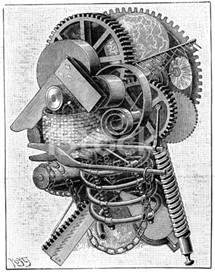
A Telling example of the new mechanical conception of the body is this 16th century German engraving where the peasant is represented as nothing more than a concoction of cogs and tubes.
Marx typically described examples of primitive accumulation from an economic perspective, such as financially crippling the working class through high living costs and low salaries. Fedirici offers alternatives such as the repression of women and contemporary theories of thought such as Cartesian Dualism. I will dissect these two themes in more detail.
Cartesian Dualism
Cartesian Dualism was a concept popularised by Rene Descartes that stated that mind and body were two entirely different entities and could exist one without the other. Fedirici uses this development in thought as an example of primitive accumulation which I found to be incredibly sensical.
She states that Cartesian Dualism laid the grounds for the alienation from the body, which Marx saw as a distinguishing trait of the capitalist work relation. As said by Fedirici, “By transforming labour into a commodity, capitalism causes workers to submit their activity to an external order over which they have no control and with which they cannot identify.” (Caliban and the Witch, The Great Caliban, pg. 142)
This form of control manifested in several ways. Fedirici states that, “Many practices began to appear in daily life to signal the deep transformations occurring in this domain: the use of cutlery, the development of shame with respect to nakedness, the advent of ‘manners’ that attempted to regulate how one laughed, walked, sneezed, how one should behave at the table, and to what extent one could sing, joke, play (Elias 1978: 129ff).” (Caliban and the Witch, pg. 168)
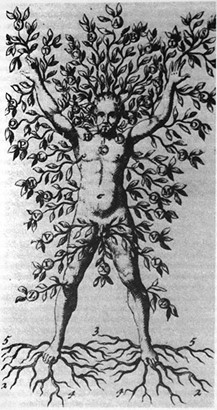
J. Case, Compendium Anatomicum (1696).
In contrast to the ‘mechanical man’ is the image of the ‘vegetable man,’ in which the blood vessels are seen as twigs sprouting from the human body.
This period marks the death of holistic and esoteric cultures and practices such as Alchemy and herbal sciences, severing an essential bond humans had to nature. In doing so, mathematics and science became the primary mode of understanding and nature became something to be conquered rather than loved and cherished.
Fedirici says, “the machine was becoming the model of social behaviour” (Caliban and the Witch, pg.157) which is reminiscent of Andy Warhol’s machine-like process of producing art. Andy told Time in 1963 that, “Machines have less problems. I’d like to be a machine, wouldn’t you?”
This quote is the end result of the effect of Cartesian Dualism which not only separated mind from body, but working class from upper class, and worker from freedom.
The Repression of Women
One key component of this period of primitive accumulation that is skimmed over in Marx’s ‘Das Capital’ is the oppression of women. Fedirici emphasises its impact in her book, uncovering its deep roots that still have effect on the world today. This is a time in history that the severity of its consequence is so easily glanced over.
In this period of primitive accumulation woman were excluded from the labour force and forced into the home through many means, such as the loss of control over sex, wages and their rights through the stigmatisation of their characters. Women were not even allowed to represent themselves in court, being declared legal ‘imbeciles’. Husbands gained control over their finances, rape was legalised against proletarian women, and they were not allowed to own anything. It was a truly horrendous period of time for women.
Fedirici talks of how this was a means of giving working class men a perceived control over their lives through the oppression of their wives in order to quell their revolutionary spirits and channel it towards their kin. Women became the enemy, not the upper classes. They did this by ridding Women of their humility and humanity, treating them like pets. An example of this is the punishment of the bridle, shown below, which was used on women with a ‘sharp tongue’. As a result women lost all power of resistance. As Fedirici says, “The definition of women as demonic beings, and the atrocious and humiliating practices to which so many of them were subjected left indelible marks in the collective female psyche and in women’s sense of possibilities.” (Caliban and the Witch, The Accumulation of Labor and the Degradation of Women, pg. 117)
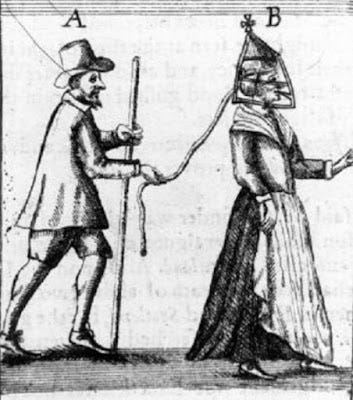
A scold is paraded through the community wearing the ‘bridle’, an iron contraption used to punish women with a sharp tongue. Significantly, a similar device was used by European slavetraders in Africa to subdue their captives and carry them to their ships.
Conclusion
This is an extremely important book that uncovers parts of History that have been hidden under the rug, but have residue that lingers in the air. This is a book that I will read many, many times and each time it will still have the same gut-wrenching effect. Fedirici exposes a past so vile and wicked that even the most twisted of dystopic authors could not imagine a world so plagued with injustice and cruelty.
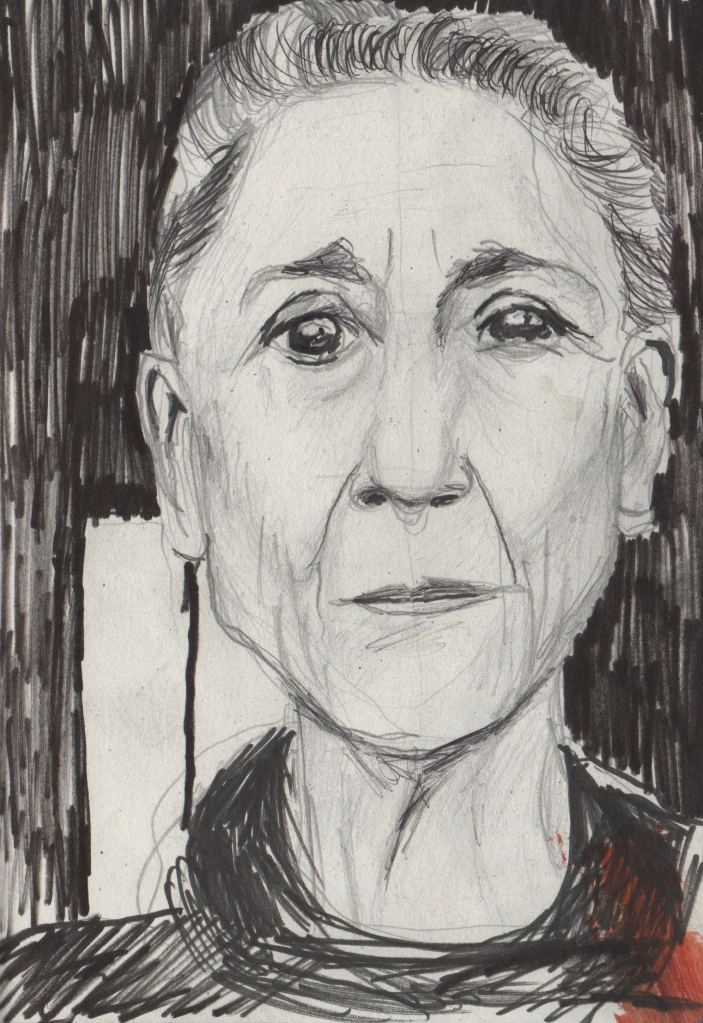
Portrait of Silvia Fedirici
Pencil and pen on paper
 Tom Allwinton Art