My most recent series of paintings, ‘Alchemy, Mysticism, and Pictograms’ have been inspired by the book ‘Alchemy & Mysticism’ which contains a catalogue of the esoteric art of the Middle Ages, giving in-depth details of the nature and reasoning behind the pieces. Art for the alchemist was not merely a job of creating an image, but a recounting of the process of extracting spirit from matter. Each piece of art reflected the divinity of these sacraments, making them like scripture.
They were created as etchings to be printed and distributed meaning they were composed of intricate line work done with a chisel.
Most pieces were considered recipes rather than artworks which means they are littered with words and instructions. Its amusing reading the chaotic revelries of these mad scientists as they described what at the time were seen as advanced concepts.
They were produced just on the cusp of the Renaissance, which evolved perspective and landscape dramatically from the traditional flat perspective. This means most of their works maintain an archaic mode of depicting space.
Religion is a fundamental glue to alchemy’s framework. At the time alchemy was at its most popular, religion was the primary mechanism for understanding the Universe, anchoring alchemical theory to religious dogma. As said by Bernouilli, “… if we are to fathom the true meaning of alchemy, we must view it not as an isolated phenomenon but in conjunction with related disciplines.”
I will discuss the elements of alchemy that I have been intrigued by and how they have informed my work and my viewpoint on the purpose of art and spirituality in our modern context.
Sephiroth
“The Sephiroth tree is at the core of the Cabala, its most influential and multi-layered symbol. The Sephiroth are the ten, primal numbers which, in combination with the twenty-two letters of the Hebrew Alphabet, represent the plan of creation of all upper and lower things.” (Alexander Roob – Alchemy and Mysticism – Sephiroth – pg .262)
For my piece ‘Sephiroth’ the Sephiroth tree is prominent. This symbol bares copious amounts of spiritual significance, originating from Kabbalah which comes from medieval Judaism. The symbol is made up of ten ‘nodes’ which are connected by pathways and separated into three categories. Each node represents a part of the human psyche, existence, or God.
The pathways usually represent the different means of travelling from one node to another, with the final node being the ‘Kether’ which is the supreme crown. If any of the pathways are blocked, one can only dwell in the lower nodes which is the cause of all evil and treachery. One must be diligent in keeping all 22 pathways clear to allow for spiritual cohesion of all 10 nodes.
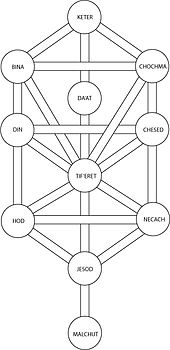
The Sephiroth Tree
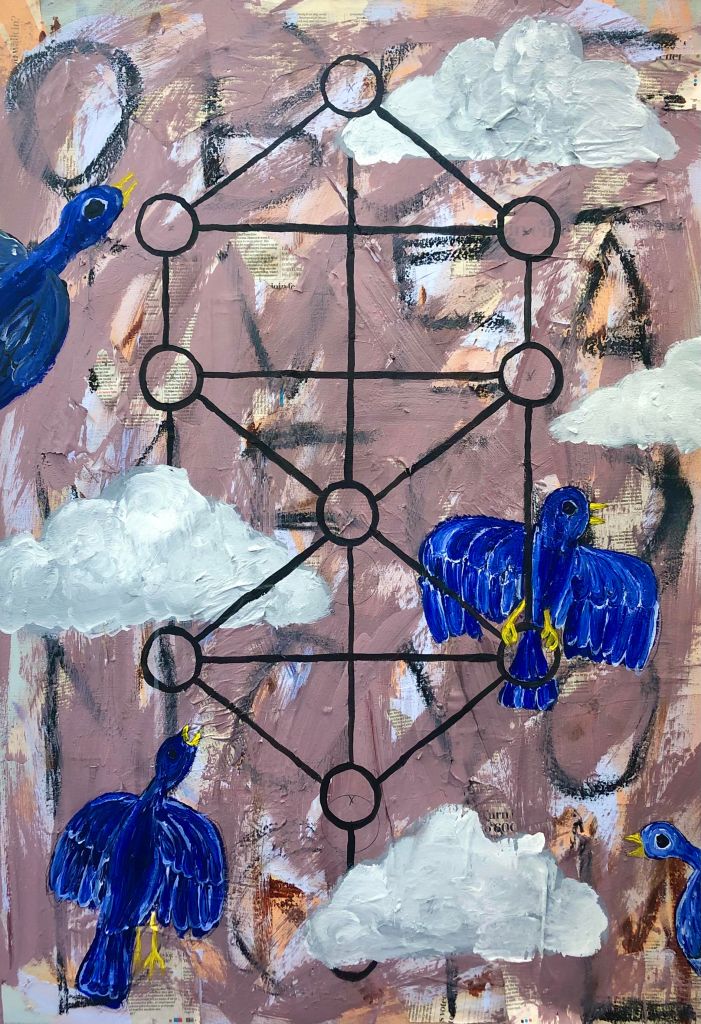
Sephiroth
Acrylic, oil stick, newspaper on canvas
2023
I utilised the Sephiroth due to my intrigue in spiritual symbolism. It has similarities to other diagrammatic expressions of the journey to enlightenment in other spiritual practices, such as Kundalini in Hinduism. In Alchemy and Mysticism, it says, “The Sephiroth forms a holistic system in which the whole propagates and reflects itself infinitely into its tiniest particles… the Sephiroth encompasses all possibilities and all combinations of the world of elements.”
We live in a spiritually depraved society, and my attraction to these holistic and eclectic mixes of religious iconography is an unconscious reaction to a lack of fulfilment to my spiritual needs. This spiritual regression is identified by Silvia Fedirici in her book ‘Caliban and the Witch’ as being a supplement of the birth of Capitalism. In her book she says, “We can see, in other words, that the human body and not the steam engine, and not even the clock, was the first machine developed by capitalism.” (Silvia Fedirici, Caliban and the Witch, pg. 158)
Andy Warhol was an artist who encapsulated the mechanistic nature of modern life in his practice. Through his use of tape recorders, screen printing, and cameras, his work reflected the industrial age of mass production more than any of his contemporaries. He went so far as to even call his studio, ‘The Factory’. In the book, ‘The Lonely City’ by Olivia Laing, he is quoted as saying, “The reason I am painting this way is that I want to be a machine, and I feel that whatever I do and do machine-like is what I want to do.” (Olivia Laing, The Lonely City, pg. 60)
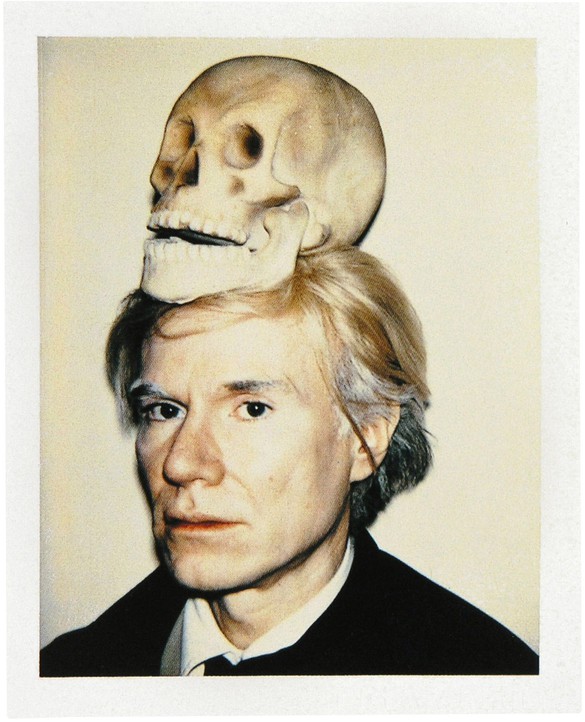
Portrait of Andy Warhol
Andy was known for speaking in a cryptic, ambiguous manner, as this quote expresses. He speaks much like how the alchemists spoke, using riddles in interviews and recordings to mask the true complexity of his work. Another quote of his goes, “I like to be the right thing in the wrong place and the wrong thing in the right place. Being the right thing in the wrong place and the wrong thing in the right place is worth it because something interesting always happens.” (Andy Warhol, Andy Warhol Exhibition, Tate Modern, 2020)
Green Lion
The Green Lion is another recurring motif in alchemy. The Green Lion refers to the spirit within matter, also known as Mercury or the Philosopher’s Stone. The sun is representative of the Logos, or the spirit, whilst the lion relates to matter. This motif of devouring is reflected in many instances in alchemical imagery, such as the king as prima materia, devouring his son.

Green Lion devouring the Sun, Rosarium philosophorum, 16th century
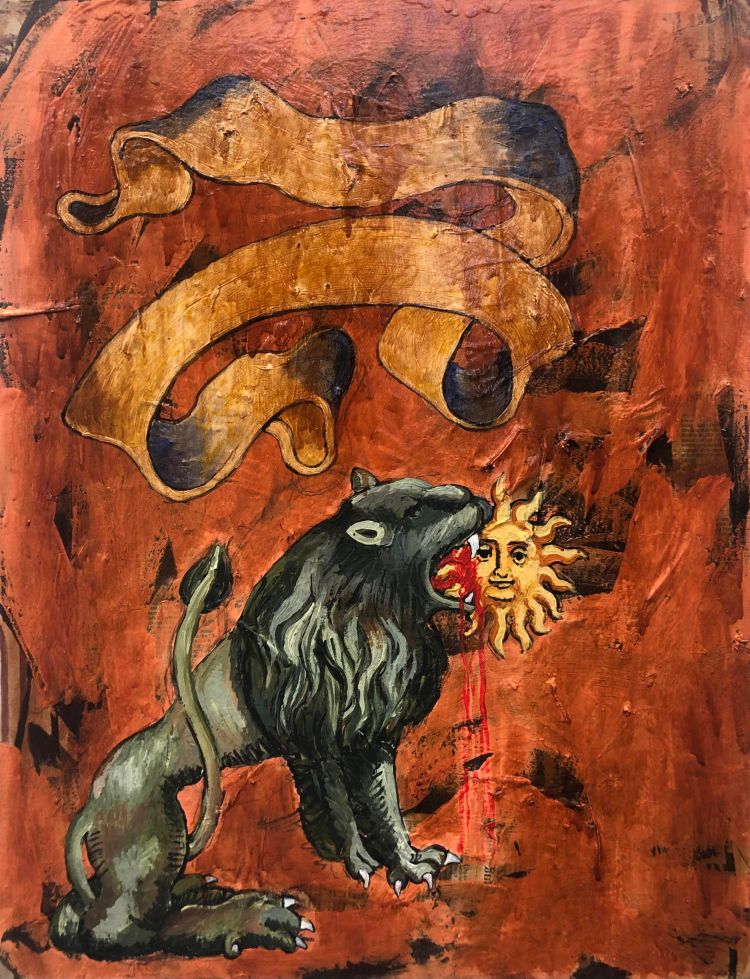
Green Lion
Acrylic, oil stick, oil, and newspaper on canvas
2023
This theme of eating the divine is common throughout many religions, such as in Christianity where during mass the priest hands out ‘the body of Christ’ for people to ingest, or during Passover where the food eaten plays an integral part in the ceremony. Paintings are also something we ingest, visually as opposed to physically. ‘Saturn Devouring his Son’ by Goya reflects this fundamental facet of art in its most gruesome form.
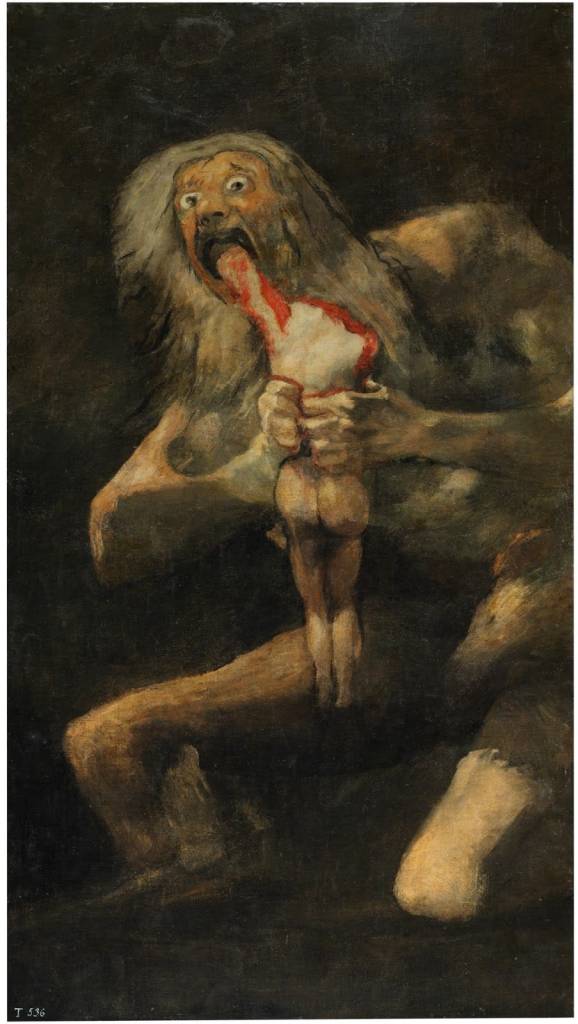
Saturn Devouring his Son – Goya
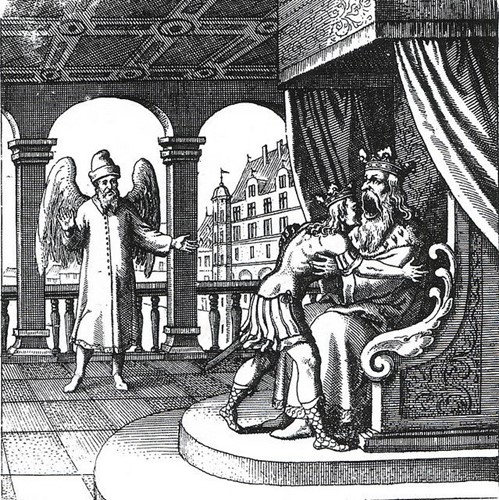
The King as prima materia, devouring his son. – Lambspringk, “Figurae et emblemata,” in Musaeum Hermeticum (1678)
The extraction of the lapis (spirit) from the prima materia (matter), was the fundamental conquest of the alchemist. The young prince represents the spirit, whilst the King represents matter. Carl Jung says in his book that, “The “treasure hard to attain,” whose presence was suspected in the dark prima materia, is symbolized by the alchemists in various ways… The precious substance is potentially contained in this chaos as a massa confusa of all the elements rolled into one, and man must diligently apply his mind to it so that “our heaven” may come into reality (ad actum).” (C. Jung, Pyschology and Alchemy, pg. 340).
This quote bears a striking resemblance to a quote from Helena Blavatsky from her book ‘The Key to Theosophy’, “The intensity of our ardent aspiration’s changes prayer into the “philosopher’s stone”, or that which transmutates lead into pure gold.” (H. P. Blavatsky, The Key to Theosophy, pg.68)
It is in this sense that the body becomes much like the alchemical furnace or vessel, devouring matter to elicit function. The furnace was an essential tool in the alchemist’s repertoire and aided in the extraction of the spiritus from the prima materia. I utilised the image of the furnace in several of my paintings in the past and in one of my recent drawings as it helps illustrate this quality of alchemy and art.
Furnace
The furnace is a recurring motif in all alchemical recipes of extraction. Every alchemist’s furnace was different, with extremely specific requirements. As said by Jung, “For the alchemists the vessel is something truly marvellous: a vas mirabile. Maria Prophetissa says that the whole secret lies in knowing about the Hermetic Vessel. “Unum est vas” (the vessel is one) is emphasized repeatedly. It must be completely round, in imitation of the spherical cosmos, so that the influence of the stars may contribute to the success of the operation.” (C. Jung, Pyshcology and Alchemy, pg.236).
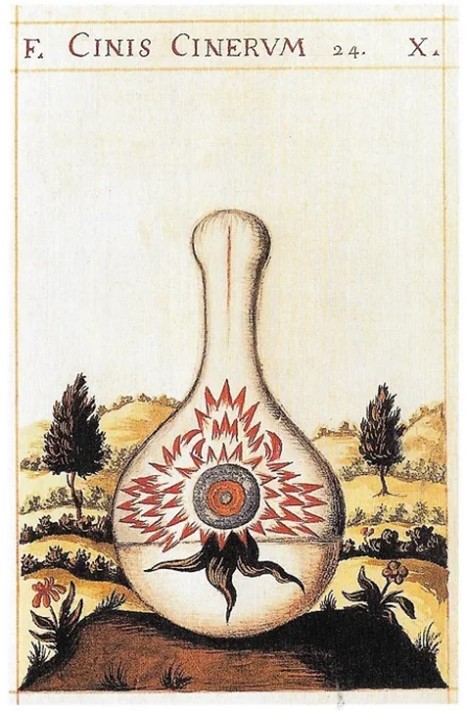
This is a plate taken from ‘Donum Dei’ which was first contained in 15th-century manuscripts and became one of the most widespread alchemical collections of quotations. Here, the stages of the work are illustrated in twelve pictures, this being the tenth.
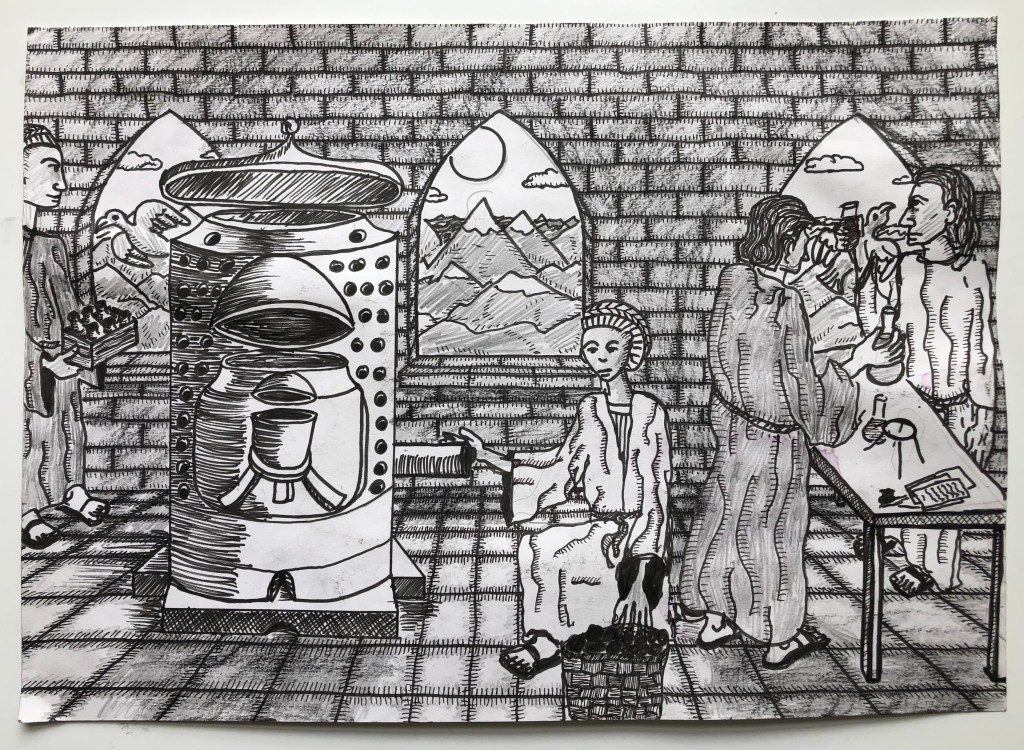
Alchemists at Work
Graphite, charcoal, and ink on paper
2023
In my drawing ‘Alchemists at Work’ I captured a scene of Alchemists at work in a castle in the mountains. There are two birds flying in opposite directions outside the windows, representing the search for wholeness.
Alchemy can be considered a pseudo- science that was more interested in the motions of the planets, stars, and the individual rather than any fundamental truths. This relates to a Jung quote where he says, “I am therefore inclined to assume that the real root of alchemy is to be sought less in philosophical doctrines than in the projections of individual investigators. I mean by this that while working on his chemical experiments the operator had certain psychic experiences which appeared to him as the particular behaviour of the chemical process.” (C. Jung, Pyshcology and Alchemy, pg. 245)
The Ladder
The ladder is used to represent the alchemical process. Depending on the source, each rung represents a different step towards the goal of transmutation. The end point is often represented as the Kingdom of Heaven, which is where the soul finally ascends the material realm. This can be represented in many ways, such as a phoenix, an angel, or simply a beacon of light.
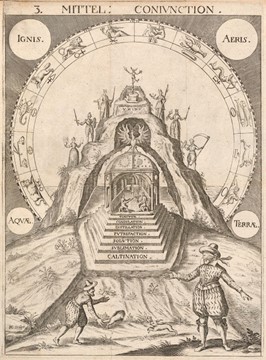
S. Michelspacher, Cabala, Augsburg, 1616
Above is a famous alchemical print depicting the alchemist as a blind man. Alexander Roob in the book ‘Alchemy & Mysticism’ says of this plate that, “The alchemist is led astray until the fleeting mercurial hare indicates the correct sources material, behind whose rough façade, via the seven steps of the process, a palace is revealed. Here the principles of Sol and Luna unite to form the lapis, the “philosophical mercury”, which crowns the dome in the form of a phoenix.” (A. Roob, Alchemy & Mysticism, pg. 259)
As to the course of the process, the authors are vague and contradictory. Many content themselves with brief summaries, whilst others make elaborate lists. In 1576, Josephus Quercetanus, alchemist, physician, and diplomate, established a sequence of twelve operations as follows:
- Calcinatio
- Solutio
- Elementorum separatio
- Coniunctio
- Putrefactio
- Coagulatio
- Cibatio
- Sublimatio
- Fermentatio
- Exaltatio
- Augmentatio
- Proiectio
Each term has more than one meaning, therefore is it pointless going into them individually at this time.
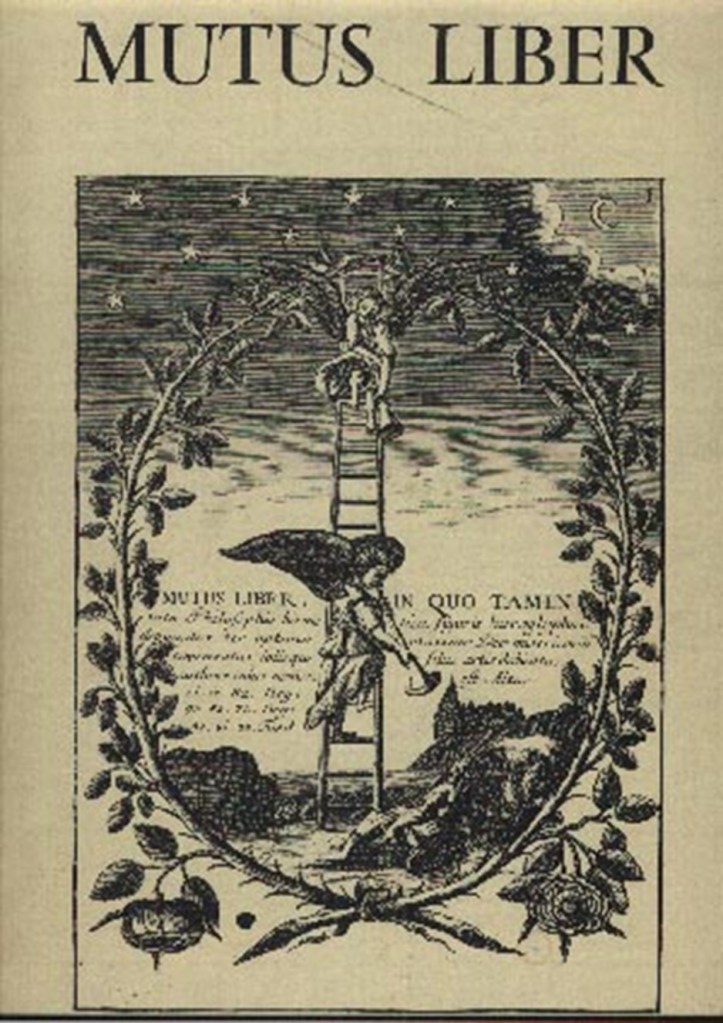
Mutus Liber, plate 1

Jacob’s Ladder
Acrylic, oil, oil stick, and newspaper on canvas
2023
For my piece ‘Jacob’s Ladder’ I took inspiration from the ‘Mutus Liber’ which was a sequence of 15 plates published in 1677 by Jacobus Sulat. I was intrigued by the angel descending the ladder and its correspondence to the theme of the process. I also found that it could take another meaning of Lucifer falling from the heavens when banished. The aim of the piece was to leave the meaning ambiguous to provoke unexpected interpretations.
The Goal of Alchemy
Through all of the grandiose drama of the process, the actual goal of alchemy is just as ambiguous and confusing as the steps it takes to get there. What alchemy boils down to is an extraction of the spirit of matter, or the Holy Ghost, to then use to conjoin Heaven to Earth, redeeming humanity and saving us from damnation.
Plato often referred to the ‘Realm of Forms’ that being where all of the archetypal design for Earthly matter originates. Freidrich Heiller says in his essay, ’Contemplation in Christian Mysticism’, “In the grandiose visions of Plato, the divine Eros leads the soul upward from the contemplation of earthly beauty to that of absolute reality, of true being, of eternal truth, goodness, and beauty.”
What Alchemy intends to do at its core is excavate the matter of these immaterial realms and make it tangible, an essentially impossible task.
Artists such as Mondrian and Kandinsky, who were part of the Theosophy Society, believe art has an integral part in reweaving the spiritual nature of man into the modern, capitalist world we live in. As said by Silvia Fedirici, “The mechanistic view of Nature that came into existence with the rise of modern science ‘disenchanted the world’.” (Silvia Fedirici, Caliban and the Witch, pg. 226).
Perhaps it is the role of the artist to enchant the world again.
Conclusion
Alchemy has been a breakthrough for me and has guided me down a long and complicated path that I am only just starting to understand. Recapitulating on the old modes of understanding has been an enlightening exercise in learning about how art and science have evolved. Alchemy is a synthesis of both, art as a means of depicting early scientific methodology.
Prior to the discovery of gravity, molecules, the solar system etc. the alchemist must have been extremely frustrated at the lack of rational within the Universe. Simultaneously, this was also liberating in that it gave them no boundaries to where their imagination could wonder, producing unique perspectives and exhilarating art.
By studying their work I have practiced exercising this unconstrained freedom of mind and tried applying it to my work, evolving my practice in new and unexpected ways.
Bibliography
- Bernoulli. R – Spiritual Development as Reflected in Alchemy and Related Disciplines – P. 1935
- Fedirici. S – Caliban and the Witch – P. 2004
- Heiler. F – Contemplation in Christian Mysticism – P. 1933
- Jung. C – Psychology and Alchemy – P. 1953
- Laing. O – The Lonely City – P. 2016
- Roob. A – Alchemy & Mysticism – P. 2021
 Tom Allwinton Art